
MindfulWell Deep Rest Series™
│
DRS
Come back to rest, one breath at a time.
Deep Rest Series™ is a small, quiet space for the parts of you that have forgotten how to stop. No performance, no pushing — just a slow, guided way back to a body that can finally exhale, and tools you'll keep using long after the four weeks end. Come exactly as you are; you're only ever asked to do what you need, never more.
Find your spotYou know the feeling. Kettle boiled, cup in hand, and your mind is already three tasks ahead. The drive home that should feel like winding down instead feels like white noise. Lying in bed, bone-tired, and still somehow wide awake behind the eyes.
That's not something willpower fixes. It's a nervous system that's been switched on for so long, it's genuinely forgotten the way back down. Deep Rest Series™ is built to remind it — gently, in small doses, at a pace your body can actually trust.
"You don't need to try harder to relax. You need somewhere safe enough to stop trying."
Three ways in to a body that's learning to settle.
You'll meet all three across the series, but never as something to push through. Take what serves you in each session, leave what doesn't, and do only as much as feels right on the day.
Somatic practice
Small, sensation-led movement — never a shape to reach for, just a body allowed to notice itself.
Calming breathwork
Simple, longer-exhale breathing that speaks directly to your nervous system's own calming switch.
Mindfulness meditation
Guided practices built around noticing, not fixing — nothing to get right, nothing to perform.
Going deeper: our guided rest practice
Every session follows the same gentle arc. It opens with slow, yin-style postures and easy movement, giving the body permission to soften before anything else is asked of it.
From there, Amy leads the group into an extended, spoken rest practice. You find a comfortable position — lying down or seated, whatever your body wants — and simply follow her voice through each stage. There's no posture to hold and nothing to get right; the practice does the work, not you.
People often describe reaching a state well beyond ordinary relaxation, properly rested without needing to fall asleep to get there. It's one of the most asked-about parts of the series, and something many people tell us they keep coming back to, week after week.
And if all you can manage that evening is lying still and breathing — that's enough. Nothing more is asked of you than what you're able to give.
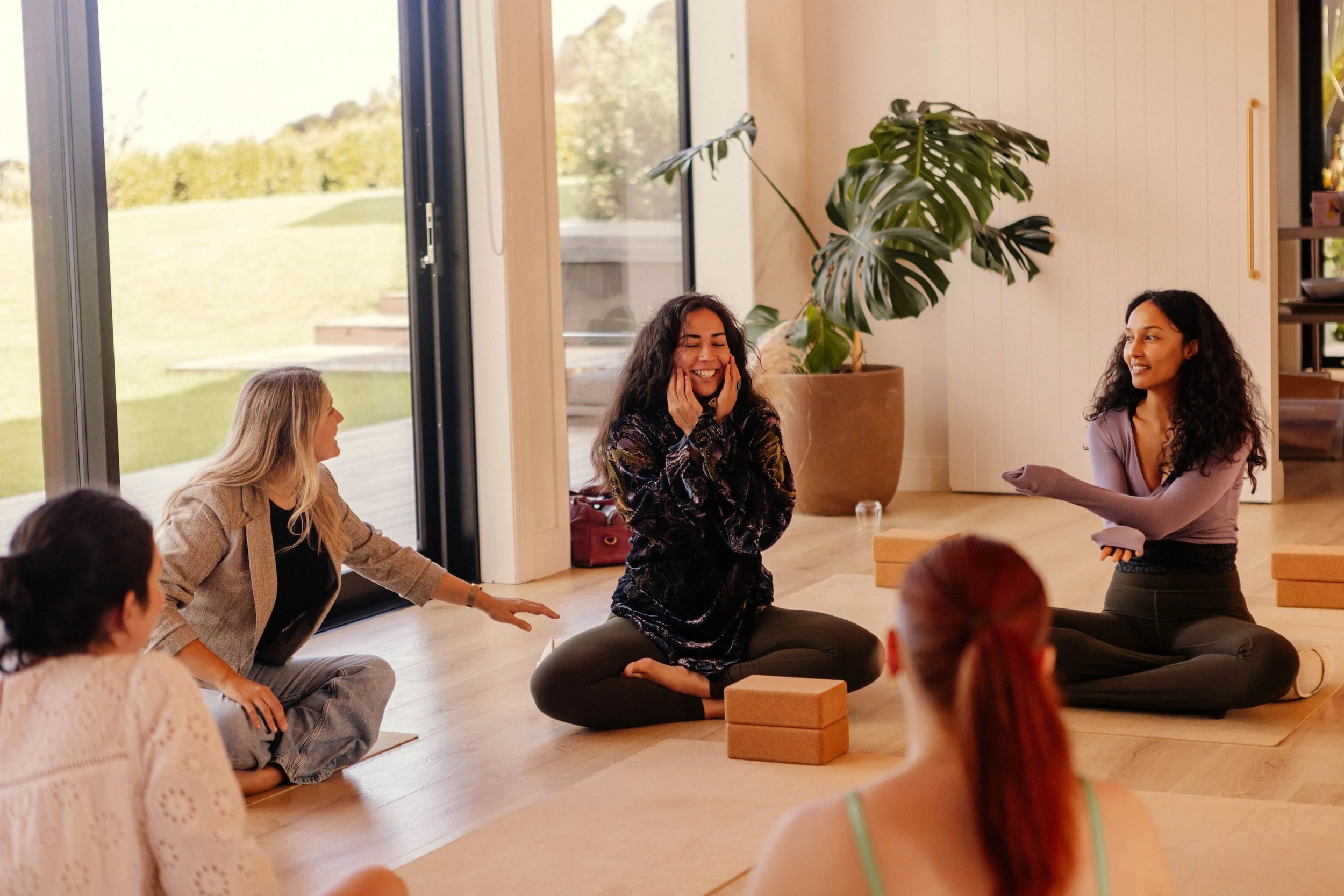
Nervous systems settle other nervous systems. It's called co-regulation, and it's one of the oldest, most human things we do for each other.
Simply being in a calm room with others who are also slowing down helps your own body find that same steadiness — often before a word is spoken. But nothing here is required of you. Sit quietly the whole time if that's what you need. Join in fully if that feels right instead. There's no version of doing this properly — just you, showing up however you're able to, session by session.
A slow build, not a sprint.
Safety & orientation
We start exactly where you are — grounding, breath, and the quiet skill of noticing.
Befriending sensation
A gentle introduction to what your body's telling you, in doses small enough to feel safe.
Settling & deep rest
The heart of the series — extended restorative stillness and real time to settle.
Integration
Weaving it together into something small and sustainable, genuinely yours to keep.
Tools that keep working, long after week four.
This isn't something you do once and leave behind. Everything here is designed to become part of how you cope — ordinary tools, for ordinary Tuesdays, months and years from now.
- A felt sense — in your body, not just your head — of what calm actually feels like.
- Simple, real tools to settle your nervous system, wherever you happen to be.
- A short, honest practice that fits your actual life, long after week four.
- More ease sitting with sensation, without it ever tipping into too much.
- A guided rest practice you can return to any time you need real stillness.
- One evening a week that belongs completely to you.
In the room, or wherever you are.
However you join, the invitation is the same: come as you are, and do only what you need — not what you think you should.
In person
Locally, together
- 4 x 1-hour sessions, weekly
- Small group — capped at 8
- Evening sessions
- Waitākere Health Hub — mats and props supplied
Online
Regulating Community
- 4 x 1-hour sessions, weekly
- Join from wherever you are
- The same trauma-informed foundations
- A space to return to, every round
Amy Reis Williams
Counsellor and somatic facilitator, and founder of MindfulWell. Amy's approach blends polyvagal theory, somatic practice, and mindfulness with a whole lot of warmth. Every session is held with patience and genuine respect for wherever you're starting from — you won't be pushed here. You'll be met.
A few gentle questions
Do I need any experience?
None at all. This series was built with complete beginners in mind, just as much as anyone with an established practice.
Will I have to share personal things in the group?
Never. Sharing is always your choice, in every session — quiet participation is just as valid as speaking up.
Is this the same as therapy?
No. This is wellbeing education and group facilitation, offered with real care but not in place of individual therapy. If something bigger surfaces for you, Amy is there to gently point you toward further support.
What should I bring?
Honestly, whatever makes you comfortable. Some people like a mat and a blanket, others prefer a cushion or just to sit as they are — there's no right kit. Come as you are, in whatever you'd feel most at ease moving and resting in.
Do I have to join in with everything?
No. Every practice in every session is optional — move if you want to move, rest if you need to rest, and skip anything that doesn't feel right in the moment. You're never asked to do more than what you need, only ever that.
There's space held for you here.
8 spots max, in person or online — and tools you'll carry with you well beyond the four weeks. Scholarship spaces available. Come exactly as you are; do only what you need.
If you'd like to explore more
Yin, fascia & rest
-
Yoga International — 5 Benefits of Yoga Nidra
An introduction to the guided rest practice at the heart of week three.
-
Simply Psychology — Non-Sleep Deep Rest (NSDR)
The research behind why this kind of rest works, in plain language.
-
beYogi — What Is Yin Yoga? A Complete Beginner's Guide
More on the slow, held postures we open each session with.
-
How Yin Yoga Affects Connective Tissue
A research-grounded look at what long, held stretches actually do to fascia — and where the evidence is still thin.
Nervous system & trauma
-
Alma — Somatic Therapy for Trauma and Nervous System Regulation
Background on the somatic, body-based approach woven through the whole series.
-
Psychology Today — Polyvagal Theory: An Approach to Understanding Trauma
An accessible explanation of the nervous-system states this series is built around.
-
Polyvagal Theory: Current Status, Clinical Applications, and Future Directions
A peer-reviewed review of the research behind polyvagal theory and its clinical use in trauma.